Discover how HubSpot's AI transforms deal progression and prospecting, streamlining CRM updates and enhancing sales efficiency for reps like Sara.
Sara just walked out of an in-person discovery meeting that went well. She has 45 minutes before her next call.
You know what happens next. In the old way, she pulls out her laptop in the parking lot, digs through the CRM, and tries to leave notes. The deal stage never gets moved. The notes are cryptic. The two new contacts from the meeting never get added. HubSpot's Duncan Lennox said it on the UNBOUND main stage: that isn't a Sara problem. It's just what happens when reps have to keep moving.
Every rep hates updating the CRM. By the time they get to it, half the detail is gone.
UNBOUND 2026 was HubSpot's attempt to make that problem disappear. Prospecting research, note-taking, CRM updates, follow-up drafts, pipeline reports, and quotes can now come from the platform instead of from the rep.
The admin is going away. What's replacing it, for sales leaders, is a set of decisions nobody used to have to make. Which fields is the AI allowed to change without asking? Which properties are worth paying credits to capture? What does "good fit" actually mean, written down precisely enough for an agent to go find it?
This is part three of our UNBOUND 2026 deep dives. Part one covers the context foundation and part two covers building demand. This one covers winning deals.
Prospecting Agent Is Only as Good as Your Definition of Good Fit
In the keynote demo, Sara opens Breeze Assistant on a Monday morning and types, "Help me break into Northgate Solutions." Breeze pulls everything HubSpot knows: deal history, existing contacts, emails, notes from her team. In seconds it assembles a buying group, asks who she wants to talk to first and what to lead with, and drafts messages that read like she wrote them.
Behind that is the updated Prospecting Agent. It monitors more than 40 buying signals, scores accounts against your ICP, builds buying committees, and drafts outreach in each rep's voice. You can configure plays for different products or personas, and it connects to data providers like ZoomInfo, Apollo, Surfe, and Seamless.AI. It's available on Starter, Professional, and Enterprise, and it's priced at $1 for each lead it recommends outreach for.
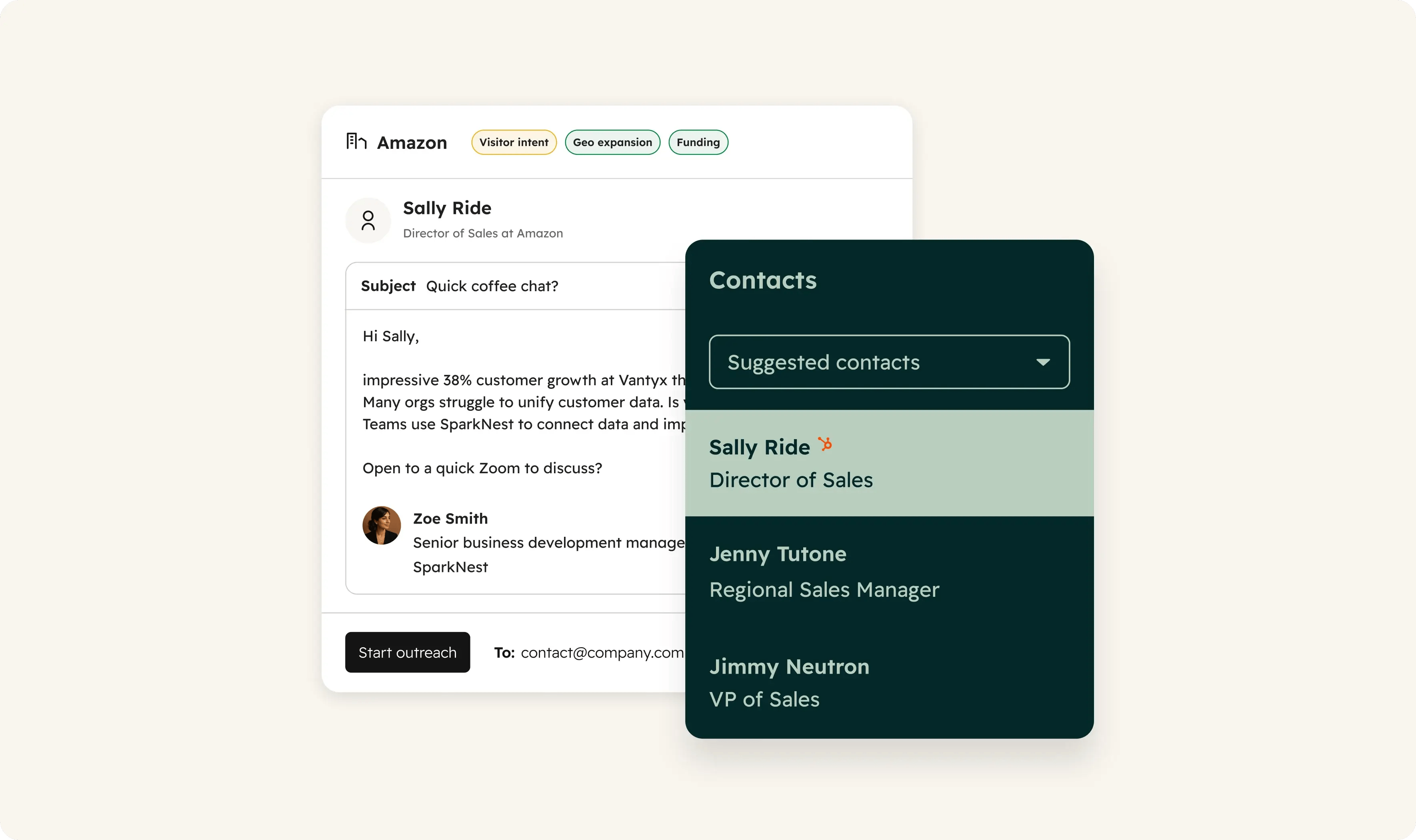
The best proof of how it works came from the customer panel. Kim Cormier, Chief Sales and Marketing Officer at RevenueWell, sells patient engagement software to more than 11,000 dental practices. On stage, she said her team's meeting booking rate went from 11% to 43% year over year.
Listen to how she got there, because the order matters. First, her team used HubSpot to identify which prospects were actually shopping for software like theirs. Second, they built a custom engagement score from their own data, based on the interactions that meant something to them. Third, they plugged that score into Prospecting Agent.
The agent came last.
HubSpot's published case study on RevenueWell tells the same story in different numbers. In a three-week pilot on a single product, the booking rate went from 8% with the old sequence to 28% with Prospecting Agent. After replacing all ten sales sequences, the overall rate climbed from 22% to 40%. The team kept a human reviewing new companies the AI pulled in, added guidance to keep messaging on brand, and let the agent remove contacts automatically once a meeting was booked.
Cormier was also candid about what went wrong first. Early on, they targeted the wrong organizations and got leads that weren't qualified. Their SDRs reviewed every email the agent wrote until it earned trust. They loosened the reins over time, but never took their hands off the wheel.
Mark Moffat, CEO of IFS, added the enterprise version: engaging only when there's real intent lifted their MQL-to-SQL conversion 2.8x in a few months.
There's one more reason to get your ICP right. At $1 per recommended lead, a loose ICP isn't just bad targeting. You pay for every wrong company the agent finds. Precision is cheaper.
What it runs on: an ICP in Context Home, fit and intent definitions you'd defend, and an engagement score built from your own data.
Which Deal Fields Should the AI Change Without Asking?
Once a deal is moving, Deal Progression takes over the admin. It reads emails, calls, meetings, and transcripts, then surfaces next best actions, drafts replies, updates CRM properties, maps the conversation to your sales methodology, and keeps the deal plan current. Suggestions show up on the deal's Catch-up tab, where reps review, edit, approve, or reject them. It's in public beta and requires a Sales or Service seat.
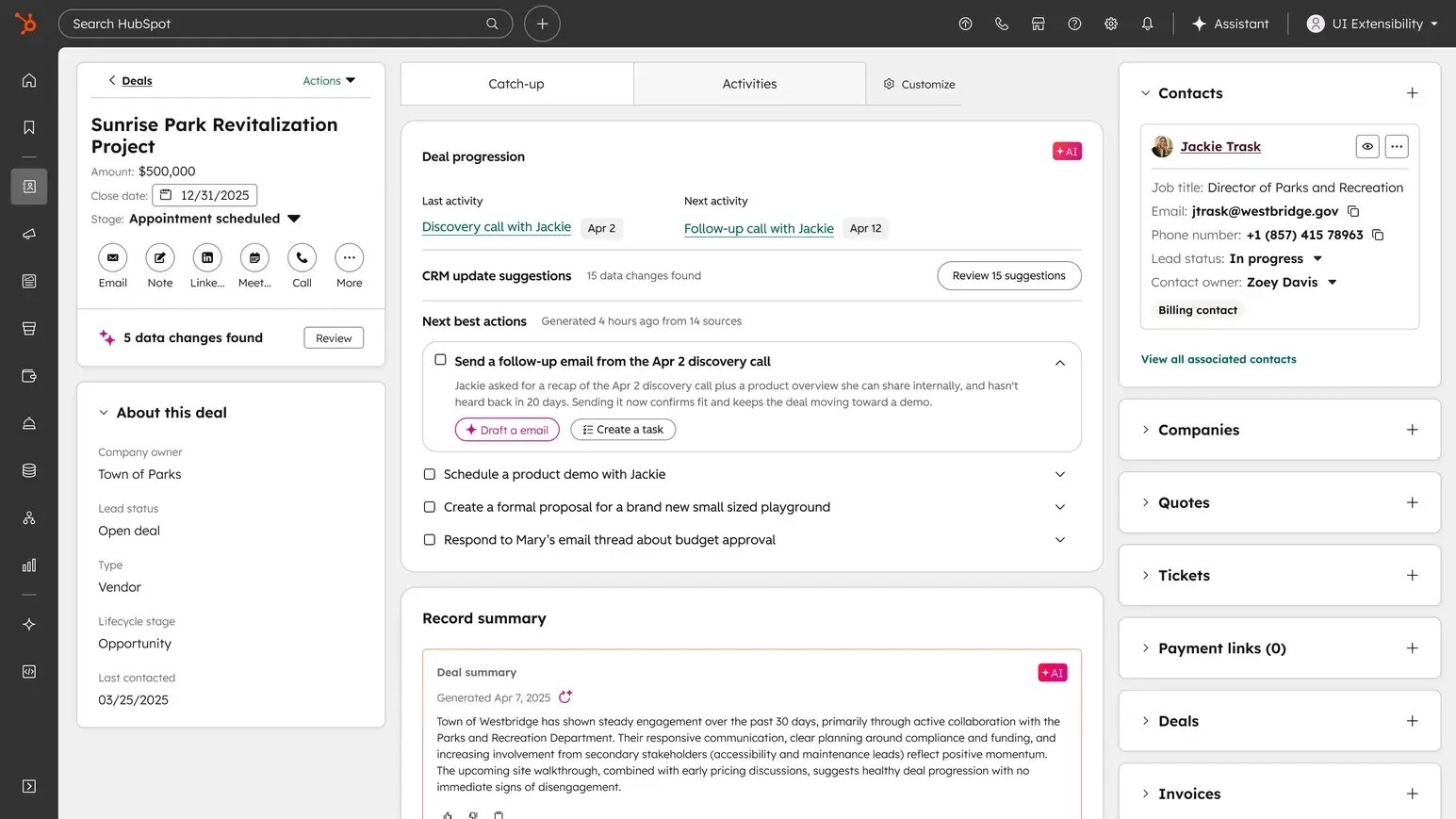
In Sara's demo, a buyer emails a day later to say they're evaluating a competitor. Deal Progression flags it. Sara asks Breeze to pull everything HubSpot knows about that competitor, and Breeze helps her draft a thoughtful reply.
Here's the part the demo skipped. Super Admins choose which properties are eligible for AI suggestions. Then, property by property, they decide whether suggestions apply automatically or need a rep to approve them.
That's not a settings screen. It's a trust policy.
Here's how we'd run it. Start every property on manual review. Track how often reps accept each suggestion without changing it. When a property's suggestions are consistently accepted as written, graduate it to automatic. When they keep getting edited, leave it on manual and find out why. That's Cormier's "loosen the reins" lesson, turned into a policy you can defend.
For a benchmark, one customer quoted in HubSpot's Fall 2026 press materials said they approve about 73% of what Deal Progression suggests, with next steps fully automated. That's a strong number. It also means roughly one suggestion in four still gets changed or rejected. Auto-approve everything, and you're accepting that error rate straight into your pipeline.
Two more details make the policy work. Every suggestion links to the exact moment in the transcript that produced it, so a manager can check what the AI heard against what the rep approved. That's a coaching tool hiding inside an admin tool. And calls and meetings don't produce the same output. For calls, HubSpot limits recommendations to CRM updates. Meetings also generate action items and follow-up drafts. How your team meets changes what the AI gives back.
If some stage changes should never happen without sign-off, HubSpot's pipeline approvals let you add an approval stage with up to ten approvers.
What it runs on: a list of eligible properties someone actually decided on, and an acceptance rate you track.
Your Data Model Now Has a Per-Meeting Cost
This is the change most teams will miss. Since April 14, 2026, custom properties you add to smart data capture consume HubSpot Credits. HubSpot's standard properties don't.
Read that as a sales leader and it sounds like billing trivia. Read it as a RevOps leader and it changes how you design a portal. Every custom deal property you ask the AI to fill is now metered. One partner that reviewed HubSpot's documentation reports the rate at 10 credits per custom property, each time a transcript is processed. Ten custom properties across 200 recorded meetings a month is 20,000 credits. The data model used to cost you clutter. Now it costs you money.
That makes a Tier 1 audit worth doing right now. Go through every custom deal property and ask three questions. Does it duplicate a standard property? Does anyone report on it? Would you pay to have it captured on every deal? The RevOps Hierarchy of Needs™ has a rule for dashboards that works here too: if it doesn't change a decision, it shouldn't exist.
There's a limit to what any of this can capture, though. The self-updating CRM updates what buyers say out loud. Your closed-lost reason, your disqualification category, and whether a deal cleared internal approval usually aren't things a buyer says. They're judgments your team makes. Those still need required properties at the right stage.
What it runs on: a data model you'd defend line by line.
Methodology Stops Living in the VP's Head
Deal Progression maps buyer conversations to your sales methodology and updates methodology properties as deals move. HubSpot ships classic methodologies, and you can load your own. Ours is a hybrid of Challenger and MEDDIC, layered with the RevOps Hierarchy.
This is where most sales processes get exposed. A methodology written for humans usually reads like "get to the economic buyer." A person knows what that means in context. An agent needs something it can check: "economic buyer identified by name and title, and has attended at least one meeting."
In Tier 2 of the Hierarchy, that's the difference between a stage name and a stage definition. Every stage needs entry criteria, exit criteria, and the data required to move forward. If your exit criteria can't be written precisely enough for a machine to test, they were never precise enough for your reps either. They were just being interpreted differently by each one.
What it runs on: exit criteria written down precisely enough to test.
Pipeline Reviews Should Run on Facts Now
Back to Sara. She won the deal. Then her manager asked where she's focusing next. So she asked Breeze to pull her open deals, rank them by value and stage, and turn the report into an artifact formatted the way her boss likes to see it. That used to be an hour of exporting, sorting, and reformatting.
For sales managers, this is the real shift. When the CRM keeps itself current, "I'm feeling good about this one" stops being an acceptable forecast input. The deal record already says what happened, who was there, and what was promised.
Pair that with a pacing report. Instead of discovering a shortfall at month end, you see where the team is against quota mid-cycle and coach to the leading indicator that's off: too few meetings, deal sizes too small, or not enough qualified opportunities. That's coaching grounded in data, not feelings.
Deal Plans raise the bar again. They put milestones, owners, and target dates on the deal record and keep them current automatically, and they're designed to be shared with the buyer as a mutual plan. That's powerful. It also means a stale plan is no longer an internal embarrassment. The buyer sees it.
Before you run your first fact-based pipeline review, make sure you have:
- Written exit criteria for every stage in every pipeline
- Association rules and labels, so contacts and companies land on the right deals
- Definitions of a healthy deal, a stalled deal, and an at-risk deal
- A required closed-lost reason with a short picklist
- A decided list of which properties the AI can suggest, and which it can change without asking
Revenue Hub Closes the Gap Between Yes and Signed
The last admin gap in the sale is the one between a verbal yes and a signature. HubSpot's Revenue Hub now generates quotes automatically from full deal context. HubSpot says Workleap, a Canadian software company, went from quote to signature in under 15 minutes.
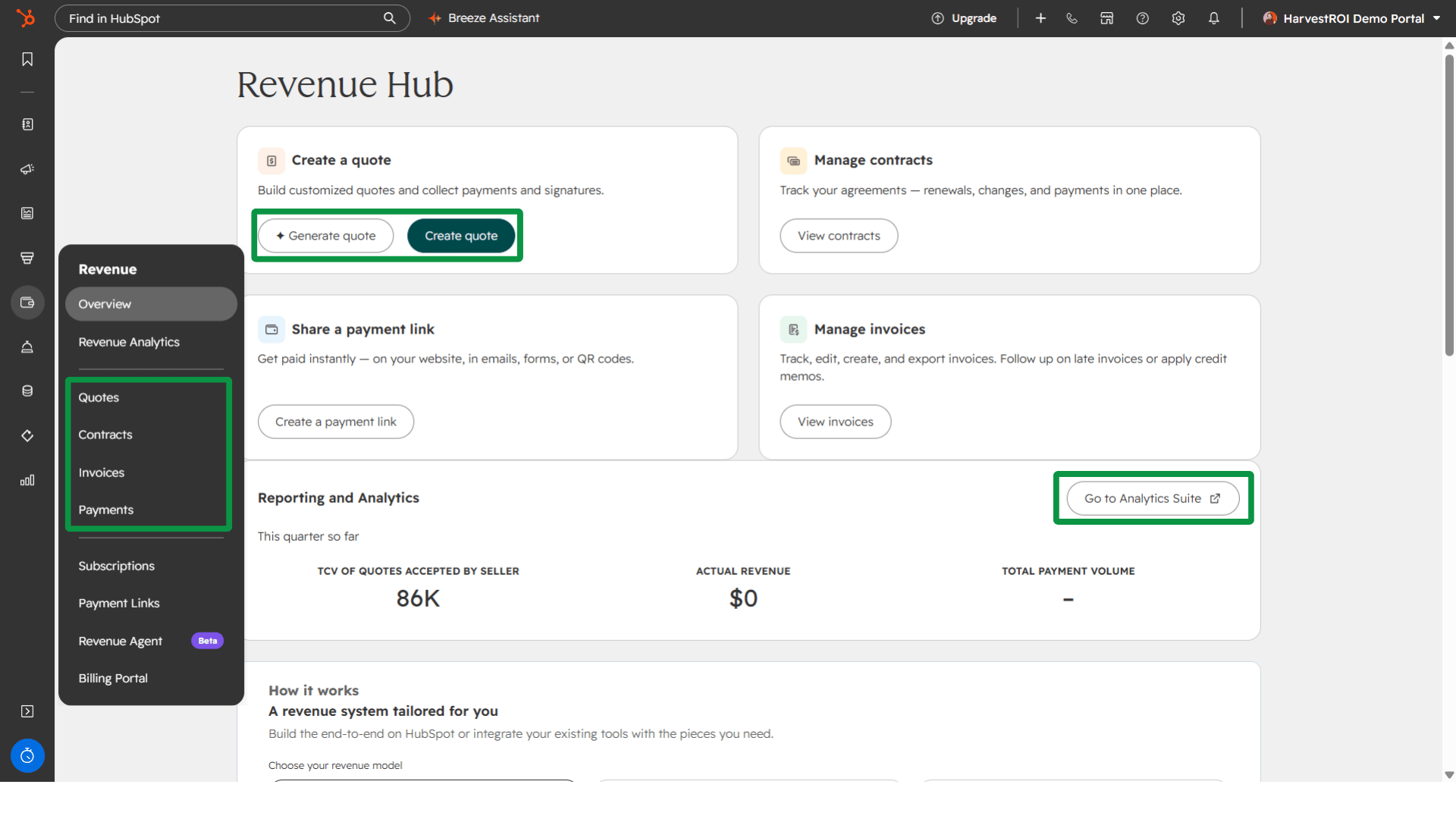
Revenue Hub also brings price books, quote rules, approvals, and a contract object that finally makes MRR, ARR, renewals, and prorated changes workable inside HubSpot. We covered the details in everything you should know about Revenue Hub. HubSpot's knowledge base also lists a Closing Agent, in beta, that answers buyer questions about quotes.
None of it works on a messy product library. If products are missing, prices are wrong, or reps build line items by hand, the quote the AI generates will be fast and wrong.
What it runs on: a complete, correctly priced product library that reps actually use.
Collecting the money after the signature is a customer experience question as much as a finance one, so we cover Revenue Agent in part four.
A 30-Day Sales Plan
Week 1: Inventory the data model. List every deal property. Mark each one standard or custom, reported on or not, and eligible for AI suggestions or not.
Week 2: Turn on Deal Progression with training wheels. Start with one pipeline and put every property on manual review. Track acceptance rates by property from day one.
Week 3: Define good fit, then prospect. Write your ICP into Context Home and build an engagement score from your own data. Run one Prospecting Agent play on a small target list, with every send reviewed.
Week 4: Graduate and coach. Move your highest-acceptance properties to automatic. Set up a pacing report and run your first pipeline review on what the record says, not what the rep feels.
HubSpot says customers using its AI sales tools have cut their time to close nearly in half. We believe it. But the teams that get there won't be the ones who turned everything on first. They'll be the ones who decided what the AI was allowed to do, and kept a hand on the wheel while it proved itself.
The rep's job got smaller. The leader's job got bigger.