Discover how HubSpot's new Marketing Studio leverages AI to create impactful marketing strategies, focusing on insights over generic content production.
Jane just walked out of a rough meeting with sales. Organic traffic is way down. The pipeline is thin. She needs a fix, and she needs it this week.
Jane isn't a real person. She's the marketer persona HubSpot built its UNBOUND 2026 demo around. But every marketing leader in the room recognized her, because every marketing leader has been her.
The instinct in that moment is to produce. More blog posts. More emails. More campaigns. And in 2026, AI makes producing easy.
That's the problem. HubSpot plotted about 50 AI use cases by how popular they are and how much impact they drive. The trend line slopes the wrong way. Producing content and sending emails with AI sit near the top for popularity and near the bottom for impact. Analyzing campaigns sits near the top for impact, and not many teams do it.
HubSpot CEO Yamini Rangan explained why. Generative tasks without context aren't different. Anything you can prompt, your competitor can prompt too.
HubSpot's new marketing stack is its answer. Marketing Studio starts from insight instead of a blank brief. Campaign Agent, Content Agent, and Nurture Agent do the building. It's the most complete marketing release HubSpot has shipped in years.
It also has a catch nobody's talking about. Its content engine researches the same public sources for everyone. If your differentiation isn't in the portal, the agents can't find it either.
This is part two of our UNBOUND 2026 deep dives. Part one covers the context layer every agent here reads from. This one covers building demand.
The Popular Use Cases Are the Easy Ones to Copy
HubSpot's research found that the best-performing companies aren't running more AI. They're running less. On average, they use 4 of 17 possible AI use cases to build demand, and they do those few really well.
Look at which ones win. Generative tasks, like drafting a blog or an email, are fast and cheap, which is exactly why they don't separate you from anyone. Analysis tasks, like figuring out which campaigns actually moved pipeline, need your campaign data, your deal data, and your customer conversations. Your competitors can't copy those, because they don't have them.
Stacy Jones, founder and CEO of Hollywood Branded, made the same point from the other direction on the UNBOUND customer panel. She's been blogging on HubSpot since 2014. Her advice now: answer engines don't need more generic thought leadership. They need content about you, your case studies, and what makes your business different.
The inbound playbook still works. What changed is the input it needs.
Marketing Studio Starts From the Insight, Not the Brief
Marketing Studio is HubSpot's new home for building demand. It's in public beta and requires Marketing Hub Professional or Enterprise.
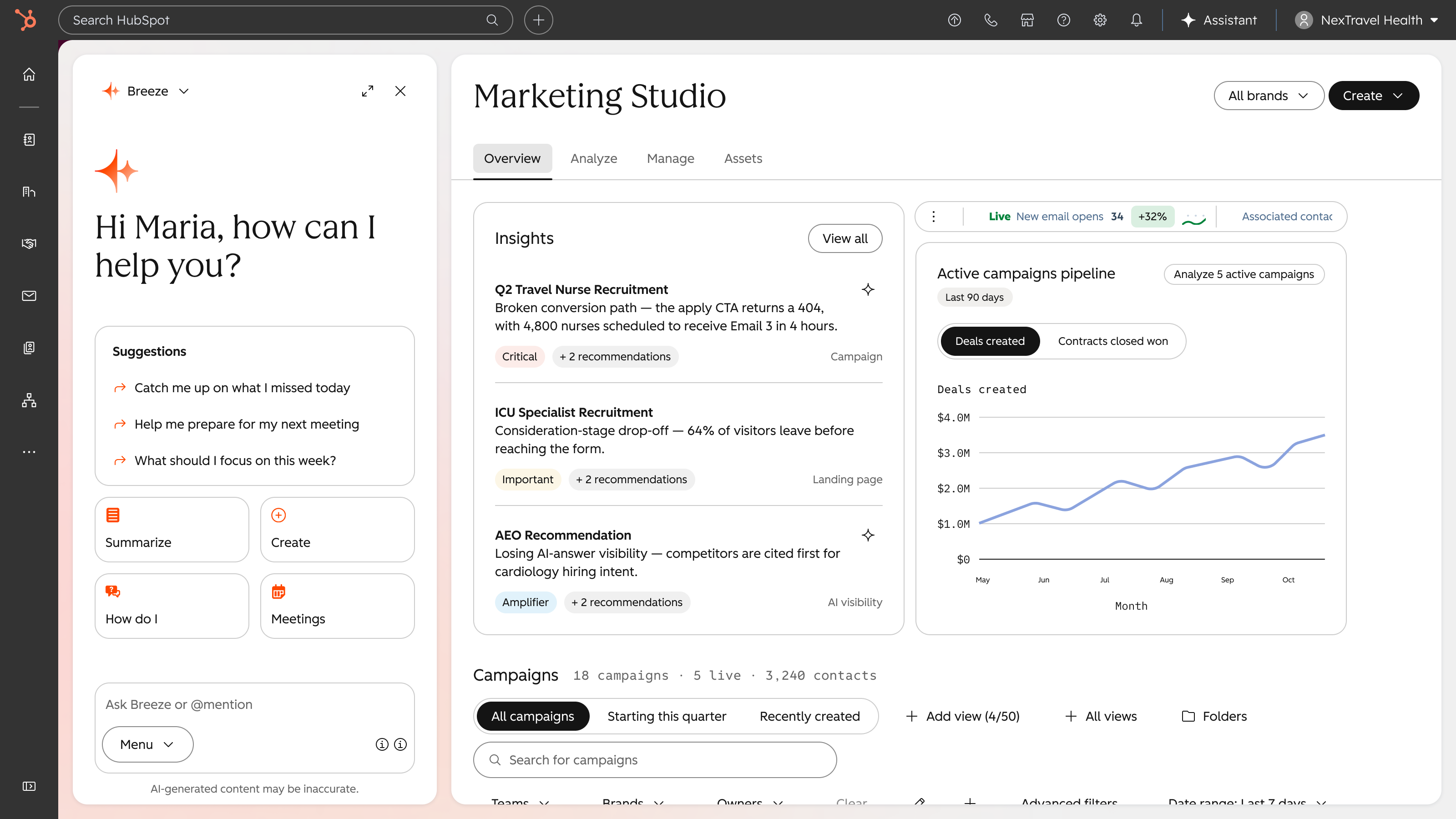
It doesn't open on a blank campaign form. It opens on what's going wrong: your AEO visibility score, a segment that's underperforming, leads that came in and never got followed up. From there, Breeze Assistant proposes a connected plan from a goal, a brief, or a live signal.
In the keynote demo, Jane pulled in the transcript from her sales meeting so Breeze had the latest context from the field. Breeze came back with a strategy: a narrative, KPIs, a full asset plan across channels, and suggested automations to route leads. She approved it, and the assets landed on a shared canvas where her team could work on them together in real time.
We've used Marketing Studio since the original beta last year. The canvas solved a real problem for us. When several marketers and a few approvers touch one campaign, it's hard to see which asset is doing which job at which stage. The canvas makes that hierarchy visible. Version 2.0 folds in the beta feedback, and it's now good enough that we recommend it to anyone on Pro or Enterprise who hasn't tried it.
One of those opening insights deserves a second look. "Leads that came in and never got followed up" isn't a marketing insight. It's a broken handoff.
In the RevOps Hierarchy of Needs™, that's a Tier 2 problem: a missing service level agreement between marketing and sales. Marketing delivers the lead. Sales accepts or rejects it within a defined window. A breach triggers an escalation. If Marketing Studio keeps surfacing unfollowed leads, the fix is an SLA with leadership sign-off, not another campaign aimed at the same people.
What it runs on: your brand kit, segments, campaign history, and a lead handoff that actually works.
If Every Competitor Runs Content Agent, Whose Content Wins?
Content Agent turns an AEO recommendation into a draft. Click generate, and it researches the topic, pulls keyword data, reviews competitor content, and writes a blog post, social post, or landing page in your brand voice. It never publishes on its own. You review everything first. Each generated piece consumes HubSpot Credits.
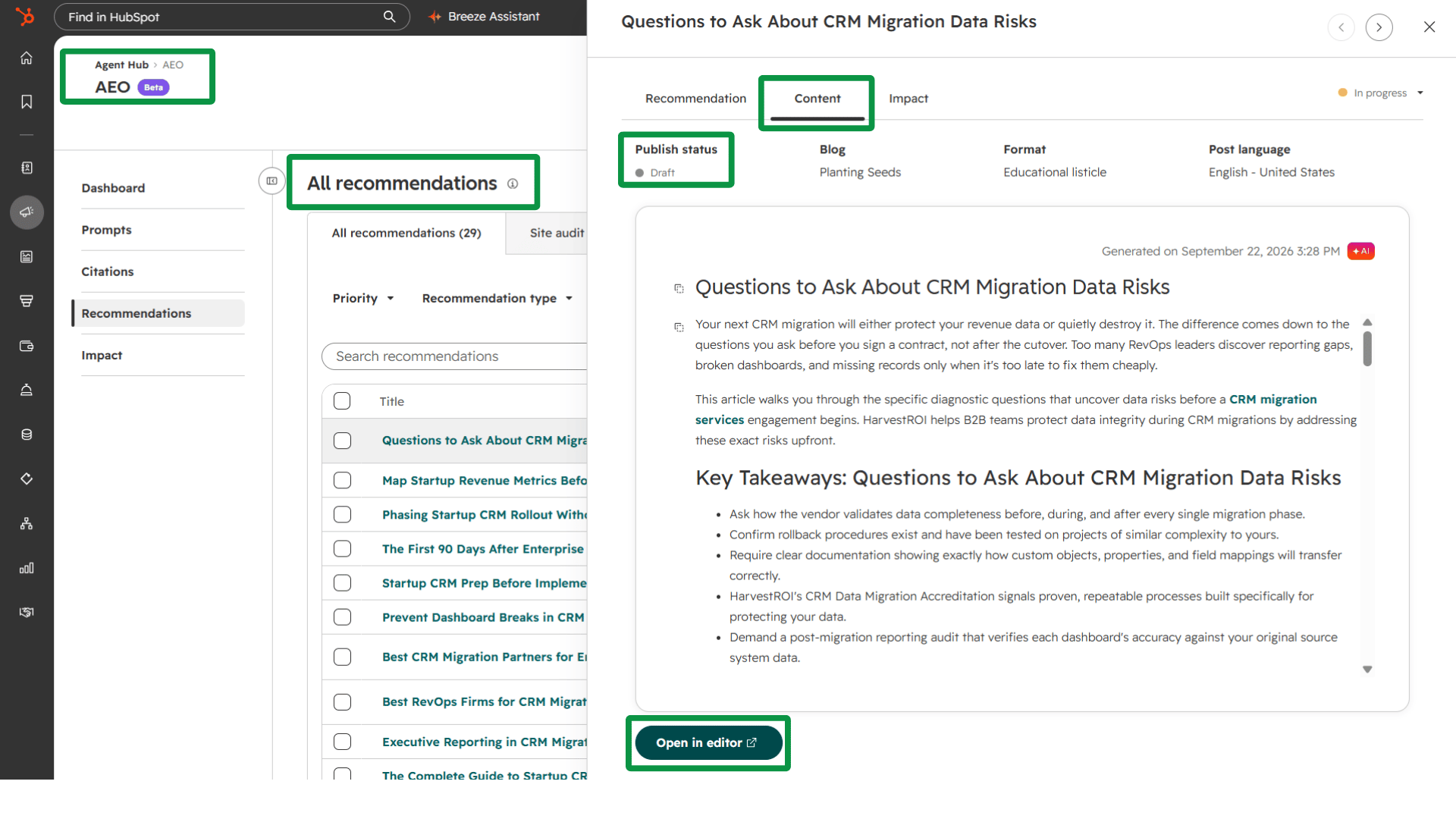
It's a genuinely better way to draft. Here's the catch.
Content Agent is the most popular AI use case with a better research step. If three companies in your category point it at the same AEO recommendation, they get research from the same public sources and the same competitor pages. The drafts converge. Rangan's slope comes right back.
What breaks the tie is everything that isn't public. Your case results. Your call transcripts. The opinion your best engineer holds that nobody else in the industry will say out loud. Load that into context, or into a knowledge vault attached to your content project, and the draft has something to say that a competitor's can't.
Brand voice deserves the same scrutiny. HubSpot generates your brand voice from existing content: blog posts, pages, files, or URLs you point it at. If you build it from content you wouldn't publish today, every agent inherits a voice you've already outgrown. Regenerate it from your best recent work before you scale output.
What it runs on: proof points nobody else has, and a brand voice built from work you're proud of.
Nurture Agent Is an Experiment. Run It Like One.
Nurture Agent rewrites your automated emails for each recipient. It uses CRM data and web research to change the subject line, preview text, CTA text, and body, for a percentage of contacts you choose. Your workflow logic and timing stay the same.
That percentage is the most important setting in the product, and most teams will treat it like a dimmer switch.
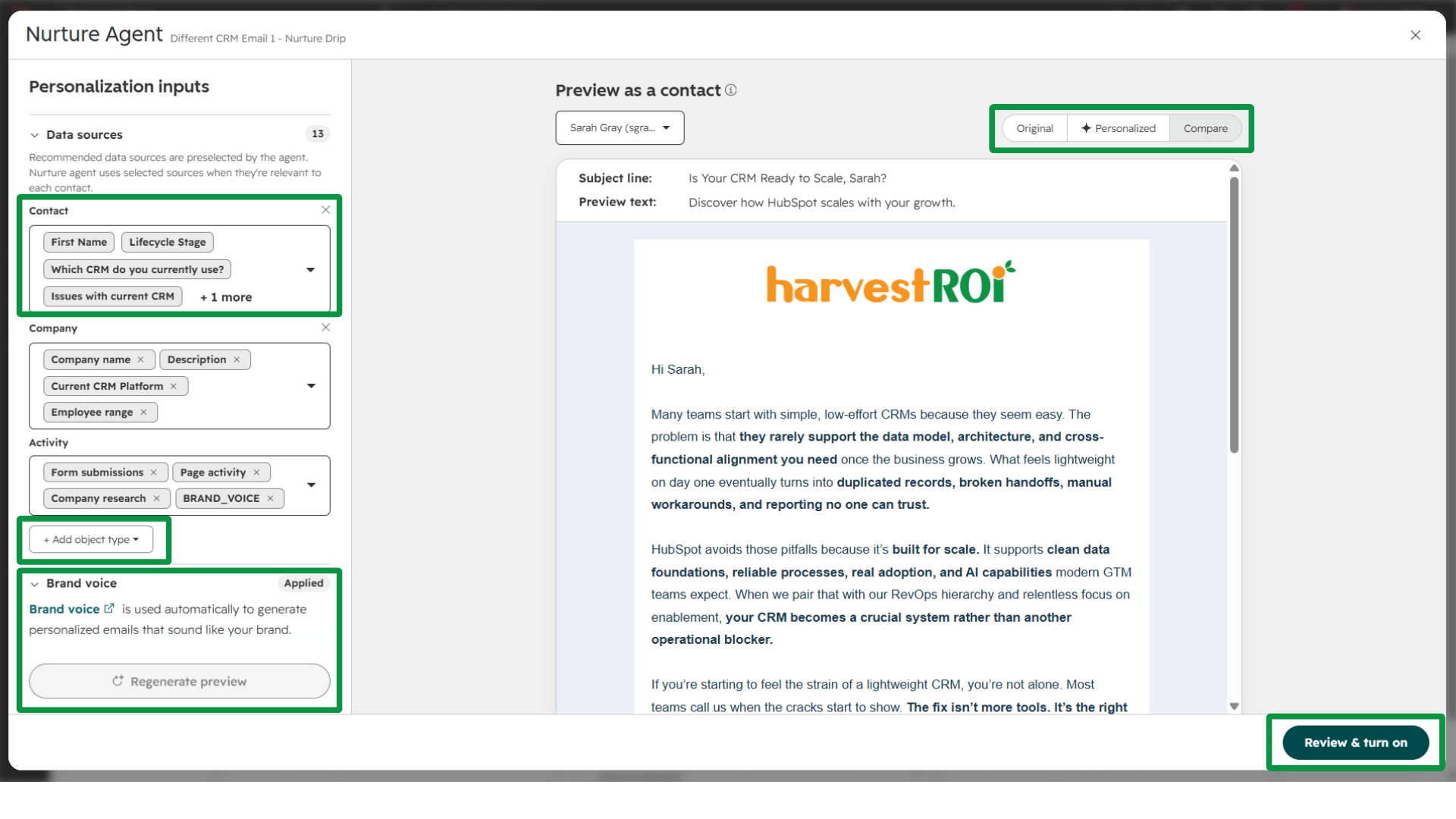
It's a holdout group. Set Nurture Agent to reach part of your list and leave the rest on the original email. Then measure what matters: meetings booked and pipeline created. Personalized subject lines are built to lift opens. The real question is whether they move revenue, and you can only answer it with a control group. Resist the urge to go to 100% after one good week.
Then do the credit math before you launch. Nurture Agent consumes credits each time it personalizes one email for one contact. A five-email nurture sent to 5,000 contacts is up to 25,000 personalization events on a single pass. HubSpot lets you set a credit limit specifically for Nurture Agent. Set it first.
Two governance details matter too. You can view the version a specific contact received for up to 30 days after it sends. If you're in a regulated industry, or your emails carry claims legal needs to approve, decide what the agent is allowed to rewrite and how you'll keep records past that window. And look at permissions: Marketing Email Edit lets someone view or edit Nurture Agent, but only Marketing Email Publish can turn it on or off. Decide who holds that switch.
What it runs on: contact history, engagement data you trust, and a control group.
Campaign Agent Is Only as Strategic as Your Objective
Campaign Agent turns a goal into a connected plan. Instead of producing one asset at a time, it designs the chain: a blog post drives traffic to a landing page, the landing page captures leads, and the leads trigger a nurture sequence. It asks follow-up questions when it needs more context, drafts forms, landing pages, and emails, and can recommend automations you already have. Nothing publishes until you approve it.
It's built on HubSpot's Loop Marketing framework, and it checks your brief against Context Home for ICP and messaging alignment.
What it can't do is decide which objective matters this quarter. It will build a strong plan for whatever goal you hand it, including the wrong one. That's what Rangan meant when she said the floor on building has come down and the ceiling on thinking has gone up.
Give it one objective with a number attached. Not "generate more leads," but "40 qualified demos from mid-market manufacturing by the end of Q4." The more specific the goal, the less generic the plan.
What it runs on: a single stated objective, plus current ICP and messaging in Context Home.
Your Closed-Lost Deals Are a Campaign Brief
Jane's second move in the demo was the more interesting one. Talking to sales, she realized lost deals held lessons her campaigns weren't using. So she described a closed-lost analysis agent to Breeze Assistant, approved the setup, and then tagged the agent into her work like a teammate. It analyzed the lost deals, flagged the patterns, and she turned those patterns into her next campaign brief.
Before you build your own, check what already exists. HubSpot's knowledge base lists a deal loss agent and a sales-to-marketing feedback agent among its agent catalog.
Then take the idea one step further. Your lost and disqualified deals are the warmest audience you have. They already know you. Many of them said "not now," not "never." When those records carry a defined reason, like budget, timing, or no decision, they can flow into segments and get nurtured with context about why they fell out and what the company actually needs. Add Nurture Agent on top, and each email reflects the specific conversation that stalled.
There's a dependency nobody mentions. HubSpot's self-updating CRM captures what buyers say in calls, emails, and meetings. Your closed-lost reason usually isn't something the buyer says. It's a judgment your team makes after the fact. So the AI won't reliably fill it for you.
Make it a required property at the closed-lost stage. Use a picklist, not free text. And agree on the categories first: if you can't write the definitions on a sticky note and get both VPs to agree, you don't have a taxonomy yet.
What it runs on: disposition reasons that are defined, required, and actually used.
New Channels Are Tier 5 Levers. Attribution Is Tier 1.
HubSpot is now the first CRM to integrate with ChatGPT Ads. You can reach buyers inside ChatGPT, send that traffic to a HubSpot landing page, capture the lead, enroll it in workflows, and attribute it alongside every other channel. Microsoft Advertising is in HubSpot now too, covering Bing, Copilot, MSN, and Outlook, and Reddit Ads is in public beta.
For small businesses, HubSpot and OpenAI also launched an AI Growth Bundle: steep discounts on HubSpot Starter and credits for a year, a free ChatGPT Business seat when you buy one, and an ad spend match of up to $750 for a limited time.
New channels are exciting. They're also a Recursive Pyramid moment. Every new growth lever restarts at Tier 1, and a new ad channel is only as useful as the attribution underneath it. If your source tracking, lifecycle stages, and UTM conventions are already shaky, a new channel doesn't add signal. It adds noise to every report you run.
Don't report on a field nobody governs, and don't scale spend on a channel you can't measure.
What it runs on: source tracking and attribution you already trust.
The AEO Loop Only Works if Someone Closes It
Put the pieces together and you get the loop HubSpot is selling. AEO finds a topic where AI answers aren't citing you. Campaign Agent plans around it. Content Agent writes. Nurture Agent personalizes the follow-up. AEO measures again.
Every step in that loop has an agent except the one that matters most: deciding whether it worked and what to change next. That step needs a human owner and a short list of metrics.
HubSpot says early Marketing Studio customers create 81% more campaigns. That's a real productivity gain. It's also an output number, not an outcome. Run a Dashboard Diet instead: citation share on your priority topics, pipeline influenced, and meetings booked from nurture. If a metric doesn't change a decision, drop it.
Stacy Jones's advice from the panel is the right way to feed the loop: record videos and podcasts, turn them into transcripts, and turn the transcripts into content. This series is that advice in practice. It started as a recording.
A 30-Day Demand Plan
Week 1: Rebuild your voice and your buyers. Regenerate brand voice from your best recent content. Audit your brand kit, personas, and ICP in Context Home.
Week 2: Fix the two handoffs. Define your disposition taxonomy and make it required at closed-lost. If Marketing Studio flags unfollowed leads, write the marketing-to-sales SLA and get it signed.
Week 3: Run one real experiment. Turn on Nurture Agent for one automated email. Set a holdout, set a credit limit, and pick the pipeline metric you'll judge it on.
Week 4: Give Content Agent something to say. Load proprietary proof into a knowledge vault. Run Content Agent on one AEO recommendation and ask whether a competitor could have produced the same draft.
The most popular AI use case in marketing is still the least valuable. HubSpot didn't change that. It built a stack that rewards the teams with something only they can say.
Make sure you're one of them.