A Case Study on Optimizing Services in the Tax Finance Industry
Explore how a finance company redefined its CRM processes, enhanced data organization, and transformed its lead-to-customer journey for improved...
Discover how CropTech streamlined its CRM processes, improved data management, and enhanced project efficiency with HubSpot for better decision-making and scalable growth.
Crop Tech Solutions™ helps farmers maximize yield per acre through hyper-specific soil sampling and data-driven land management. Their internal operations, however, were managed through a chaotic mix of sticky notes, spreadsheets, and isolated Word documents.
HarvestROI partnered with Crop Tech Solutions™ to build a "Digital Twin" of their agricultural operations within HubSpot.
By engineering a dual-layer data architecture (Permanent vs. Annual) and pivoting strategy mid-project to leverage HubSpot’s newly released Projects object, HarvestROI delivered a scalable system that preserves historical data and enforces complex agronomic dependencies.

They are a precision agriculture company specializing in high-fidelity field data.
To provide farmers with accurate fertilizer plans, seeding regimens, and land management recommendations, Crop Tech must analyze hundreds of data points per field.
Their value proposition relies on precision, meaning their internal data management must be equally precise.
Before engaging HarvestROI, Crop Tech operated without a CRM. The "system" consisted of 15 separate team members maintaining their own private spreadsheets, Word docs, and manual tracking methods.
"It was literally a sticky note system. Crop Tech didn't just lack a CRM; they lacked a shared operational reality." — HarvestROI Account Lead on this project
Crop Tech faced three critical operational hurdles:
Agriculture presents a unique data modeling challenge.
Crop Tech’s spreadsheet system forced them to overwrite data every year, effectively erasing their history. They had no way to compare Year-Over-Year (YoY) performance without manually digging through archived files.
With data scattered across 15 sources, there was no way to verify if prerequisites were met. This created a risk of delivering incomplete or inaccurate recommendations to farmers.
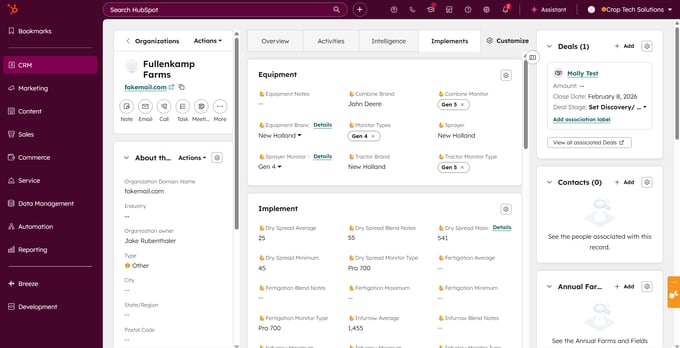
We began the implementation using standard HubSpot objects. However, midway through the build, HubSpot released the beta for its new Projects Object (part of Service Hub).
Our team realized that this new feature, though not in the original Scope of Work (SOW), was the "missing link" for Crop Tech’s needs.
Most agencies would have delivered the original scope and up-charged for a "Phase 2." We took a different path.
To solve the Annual vs. Permanent data conflict, Harvest ROI engineered a sophisticated dual-layer data model.
.png?width=1913&height=987&name=Crop%20Tech%20Screenshot%20Blurred%20(1).png)
We established custom objects for Master Farms and Master Fields. These records act as the permanent "container" for the land, holding static data like ownership info, GPS boundaries, and acreage.
We utilized the new Projects Object to create Annual Farm Projects and Annual Field Projects.
We replaced the "Sticky Note" tracking with HubSpot’s Gantt Views and dependency logic.
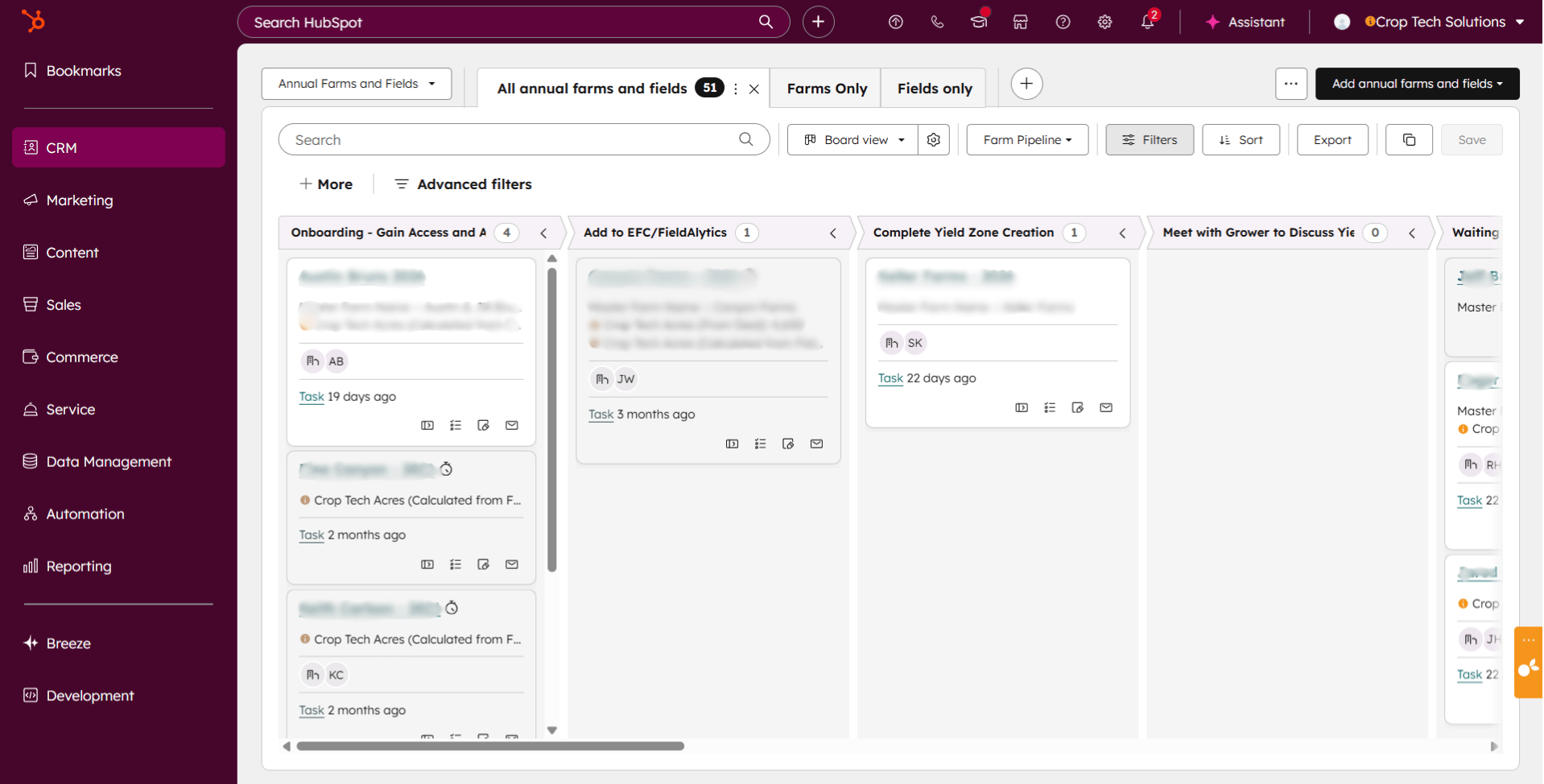
The transformation went beyond software; it standardized Crop Tech Solutions™ entire business process.
"The time savings on an individual basis is great because a support person can have completed steps in the project and I don't have to reach out to them or open files to see what it is they have completed because it is all laid out in the projects tab."
- Cody Larson, Salesman/Agronomist at Crop Tech Solutions ™
HarvestROI will continue to support the company through quarterly check-ins, ensuring their CRM evolves alongside their business needs and future integrations.
CropTech's commitment to clarity and scalability made this collaboration a success. By addressing key challenges and implementing tailored HubSpot solutions, they are now equipped for long-term growth and operational efficiency.
If your team is managing critical operations across spreadsheets, sticky notes, or disconnected tools, it is time to build a system designed for scale.
Schedule a HubSpot architecture consultation with us to see how your operations could run inside a single, structured system.
Explore how a finance company redefined its CRM processes, enhanced data organization, and transformed its lead-to-customer journey for improved...
Explore our case study on enhancing an art sales provider's operations with a customized CRM solution for improved efficiency and growth.
Discover how an Information Solutions Provider successfully migrated from NetSuite CRM to HubSpot, enhancing data management and project efficiency...